



Carmen Sánchez Sánchez-Mármol, found a way to fulfil her spiritual quest within the Teresian Association when she attended Cedar Court residential school (Surrey, England) as a student to study English. The joy and enthusiasm she witnessed there prompted her to become a member of the Association shortly afterwards back in Spain. Although she was reluctant to continue her studies, this new direction in her life served as the spur that encouraged her to study English Language and Literature, eventually leading her to a career in teaching.
In this field, she has played a significant role in establishing high-quality teaching methods which, following a long career and a series of achievements, have given rise to the ‘Accordion Movement’. She remains active today through the Official College of Teachers of Madrid (CDL) and engages in various activities. She has also co-edited, alongside the English teacher and professor María Luisa Ariza Brigidano, the recently published book ‘An Integrated Approach to Education’ (El enfoque integrado en la educación Narcea Ediciones).
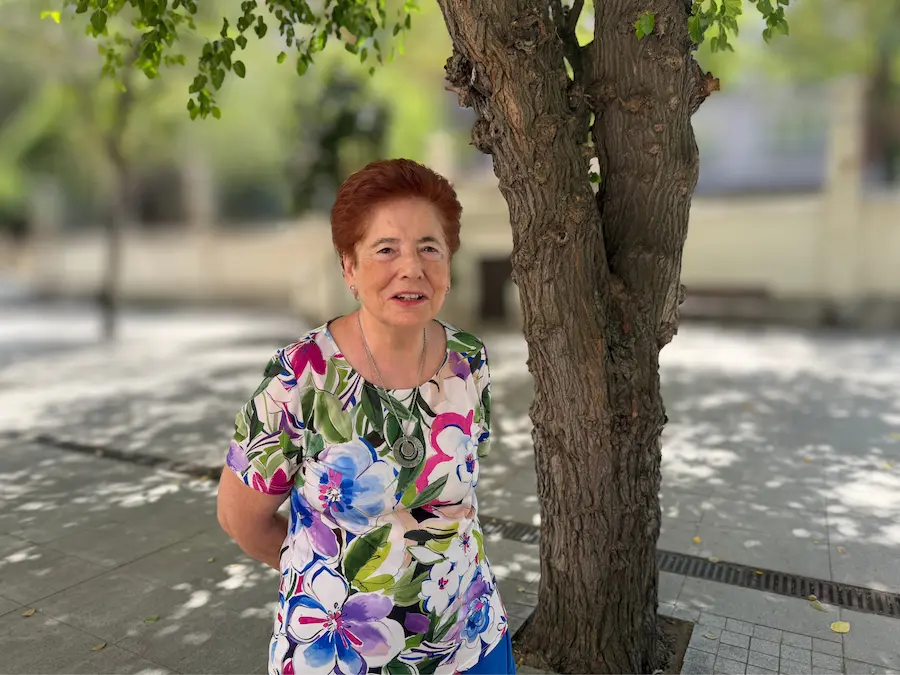
Carmen Sánchez Sánchez-Mármol, a native of Madrid’s Chamberí neighbourhood, was an English teacher at the Instituto Veritas (TA Comprehensive School in Madrid) for over 40 years and Head of the English Department there for around 20 years. At the same time, she devoted herself to teacher training and advising educational centres, both within the Teresian Association and externally, as well as other organisations –both private and public– such as the Ministry of Education. Although she is retired, she continues to contribute to the world of education through her collaboration with the CDL and other activities, because ‘they keep asking her to,’ she says.
In this interview, she speaks not only of her spiritual vocation but also of her professional one, which she has combined and embodied in a way of life that defines the members of the Teresian Association.
How did you come to know the Teresian Association?
I ended up in the TA quite by chance. I had been educated at a religious school and, when I reached my teens, I said I did not want to study. So my parents took me to the Cedar Court in Surrey in England –which belonged to the TA– to learn English. Several things caught my attention there. I had always had a spiritual longing, and I noticed a great sense of enthusiasm among the members living there at the time.
That desire to make a difference in education, combined with a deep and genuine faith, moved me deeply. I was also struck by the joy with which they were preparing for their future mission.
Once back in Madrid, I kept in touch with some friends from the TA, and shortly afterwards it became very clear to me that I wanted to become a member; not only because of the mission, but to dedicate my life to something that would fulfil me, something that was evangelical and committed; a vocation of serious, solid and lasting commitment. I felt that this was my vocation too.
What have you learnt in the course of your career?
I have always enjoyed developing my skills and innovating in the classroom, because otherwise I get bored. At the Veritas Institute, we had a personalised education programme which was very rigorous and important for the TA as it bore the hallmark of Pedro Poveda by encapsulating his vision of what education is. The teaching staff at the school lived and breathed this philosophy – that is to say, education is the interaction between the teacher and the learner that takes place in the classroom. The teacher must bring out the best in the learner and help them to grow as a person.
I consider this to be of the utmost importance, and it is given great consideration in personalised education, as it is tailored to each individual pupil. This is a fundamental aspect of Pedro Poveda’s pedagogical philosophy.
When did you realise the importance of continuing professional development for teachers and decide to dedicate yourself to it?
Any teacher or person in general should avoid becoming stagnant. This was very clear in the courses on personalised education offered at the school. It is a perspective I learnt there and which helped me progress a great deal.
I enjoyed teaching and wanted my lessons to be the best they could be. I attended training courses at the British Council, and was subsequently invited to lead sessions there.
At that time, the Somosaguas Institute of Pedagogical Studies (IEPS) –established by the TA as a centre for educational research and teacher training– was in operation. Its director at the time, Arantxa Aguado, asked the English Department at the Veritas Institute to be involved there. At the same time, the Official College of Teachers of Madrid asked me to join its Permanent Teaching Seminar in the field of English.
Then I received calls from other places – private organisations, the Ministry of Education… I believe this is part of my Teresian vocation, which is not confined to the classroom but also involves spreading the word about what the Teresian Association can contribute in this regard.
 Madrid Book's Fair 2026 poster.
What does the Teresian Association contribute to teacher training?
It can contribute a great deal to this training, not only to those who profess a particular ideology but to any teacher. Pedro Poveda was noted for his total commitment to Catholicism, yet he was not closed and did not confine himself to one place; he wanted to reach every corner. He was completely open-minded because he had a very clear understanding of what education entails.
Pedro Poveda evangelises through the person, not through dogmatism that might exist in a particular school or within the Catholic Church. I always refer to a quote of his that defines what education means to him:
‘Education is a two-way process involving two people: the educator, who consciously stimulates, guides and fosters the growth and development of the learner’s whole being; and the learner following the path laid out by the educator and whose whole life is expanded, gradually strives to achieve perfection through the repetition of these processes.’
That encapsulates everything you need to work on. If you expand on this, it leads to a tremendous renewal and innovation in teaching.
When the decision was taken to introduce bilingual education in schools in the Community of Madrid, what was done at the Instituto Veritas?
In 2007, it was decided that bilingual education would be introduced in schools in the Regional Community of Madrid, but no details were given as to how. So, at the Instituto Veritas, we put forward a project in which we combined the teaching of English with another subject: Natural Sciences or Social Sciences. We had already implemented this methodology at the school and knew it worked. We submitted it to the Community of Madrid, and in the first year they approved our school as the only state-subsidised private school to implement it alongside other state schools in the region.
You have just contributed to a book about the ‘Accordion Movement’ – what was that process like?
Back when the Somosaguas Centre was still in existence, we English teachers set up a research group called the ‘Pygmalion Team’ in the 1980s. When Somosaguas closed, we continued at the CDL and, over time, we began to realise that everything we had developed was pure methodology, suitable for any subject, not just English. Then, at the Teachers’ College, another team emerged, joined by teachers of subjects other than English, which was called ‘Hypatia’.
 We then realised we needed to do more –to create a broader movement. We also discovered that what set us apart was our coherence, the integration of all elements: from the general approaches right through to classroom practice. That is why someone on the team said it was like an accordion, and from there we began to refer to the ‘Accordion Movement’.
We decided we had to capture all this in a book, so I approached Mónica González, director of Narcea Ediciones. She was very supportive, and after a year and a half of work we published ‘An Integrated Approach to Education’. It is a book that beautifully reflects this work spanning so many years, the result of much thought and reflection.
The book provides guidance on, among other things, the challenges faced by teachers, discipline, motivation, etc. Why do you think motivation is on the wane?
It is very difficult for teachers to stay motivated. It is not something that can be taken for granted. There is an excessive amount of bureaucratic work that serves no purpose. Little attention is paid to teachers’ emotional wellbeing, so ultimately their enthusiasm wanes. They find themselves isolated, and it is true that there are fewer and fewer people entering the teaching profession. Given everything we are currently experiencing, we need to spearhead some kind of action, and it is very important that the Teresian Association should be involved.
Teresa Rey, TA Info.
(Accordion image edited with AI).
 Published in News