



Anyone interested in learning about the life and work of María Dolores Gómez Molleda need only go online where they will find several articles providing information about her life and work. For example, they will learn that she was born in Colmenar Viejo, a village in the Community of Madrid at the foot of the Sierra de Guadarrama, on 15 September 1922. She was the youngest of six siblings. The year after her birth, her father died very young in a car accident.
She completed her secondary education in Madrid and studied Philosophy and Arts at the Complutense University specialising in History and from which she graduated with highest honours in 1946; a year later, she joined the Teresian Association.
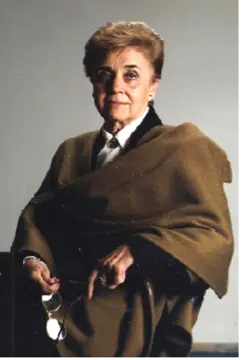 She completed her doctoral thesis with a grade of ‘outstanding’ in 1949. She was a research fellow at the Jerónimo Zurita Institute of the Spanish National Research Council, secretary of the School of Modern History, and assistant lecturer in Contemporary Spanish History at the Faculty of Philosophy and Arts of the Complutense University. In 1967, she was appointed to the chair of Contemporary History, first in Santiago de Compostela and later in Salamanca.
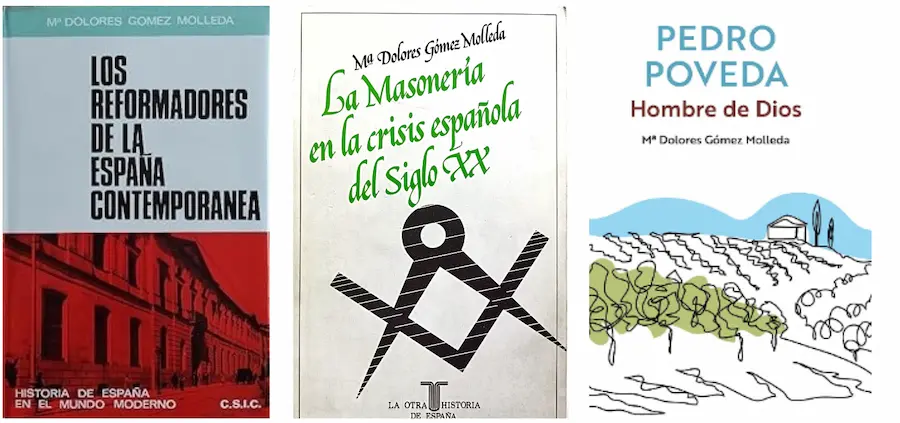
She was awarded the National History Prize for her book Los reformadores de la España contemporánea; she is the author of many other books and articles; she served on the Governing Board of the Ateneo; she was a member of the Royal Academy of History; she was director of the Unamuno House-Museum in Salamanca, and served as vice-chancellor and chancellor of Salamanca University, retiring in 1988 at the age of 65 to become professor emerita. These and even more noteworthy details can be easily found.
Within the Teresian Association, she was editor of the journalsCrítica and Eidos. She was the founder and director of the Narcea publishing house, which published her first books on Pedro Poveda; she was also the editor of the *Bitácora* series.
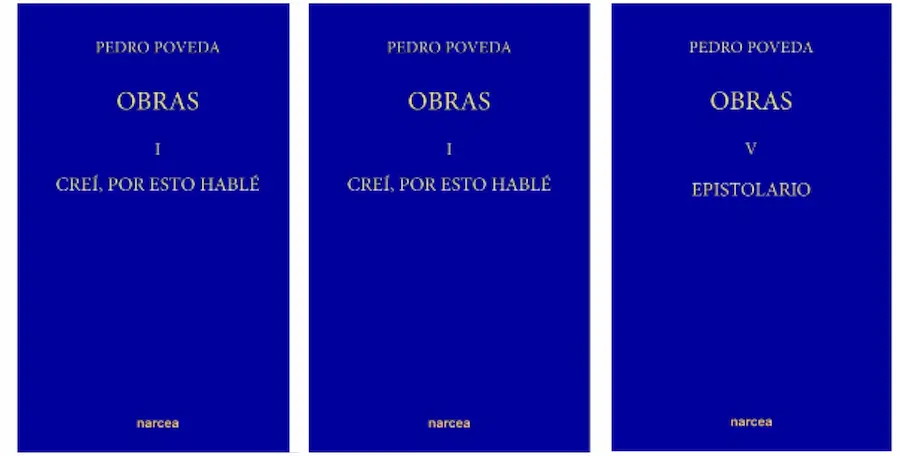
However, her greatest satisfaction – which does not feature in her brilliant public record – was the launch of the critical edition of the writings of Saint Pedro Poveda and the publication of its first volume, *Creí por esto hablé* (I Believed, Therefore I Spoke), which appeared in 2005; this is an essential work for anyone wishing to understand the thought and spirituality of the founder of the Teresian Association.
Furthermore, she laid the groundwork for further volumes that would round out the portrait of Poveda. a great educator and saint; the team she established in Salamanca is carrying on this great work of which other volumes have already been published: Ensayos y Proyectos Pedagógicos [Educational Essays and Projects] and Institución Teresiana. Reglamento y vida interna [The Teresian Association: Directory and Internal Life], edited by Margarita Bartolomé and Arantxa Aguado, as well as two volumes of letters written by Pedro Poveda: Epistolario 1898-1917 [Correspondence 1898–1917] and Epistolario 1918-1924 [Correspondence 1918–1924].
From this extensive collection, those remaining to be published are the critical edition of the Diario [Diary] and two further volumes of letters extending up to 1936, the year in which Pedro Poveda died a martyr bearing witness to his faith.
One might think that, being such a distinguished and highly regarded intellectual, she would not be easy to approach. But this was not the case. She was friendly and had a good sense of humour; witty and humble and very engaging. This was confirmed by the university students who were invited to ‘reading groups’ on current affairs and came to know the Teresian Association and by students she helped during their university studies.
After almost thirty years devoted to this research work for the TA, M.ª Dolores Gómez Molleda passed away in Salamanca on 10 October 2017. Hers was a life dedicated to education; a Catholic scholar who followed in the footsteps of Poveda to help unite faith and culture.
Pilar Pazos.
TA Translation Team.
 Published in Profiles